
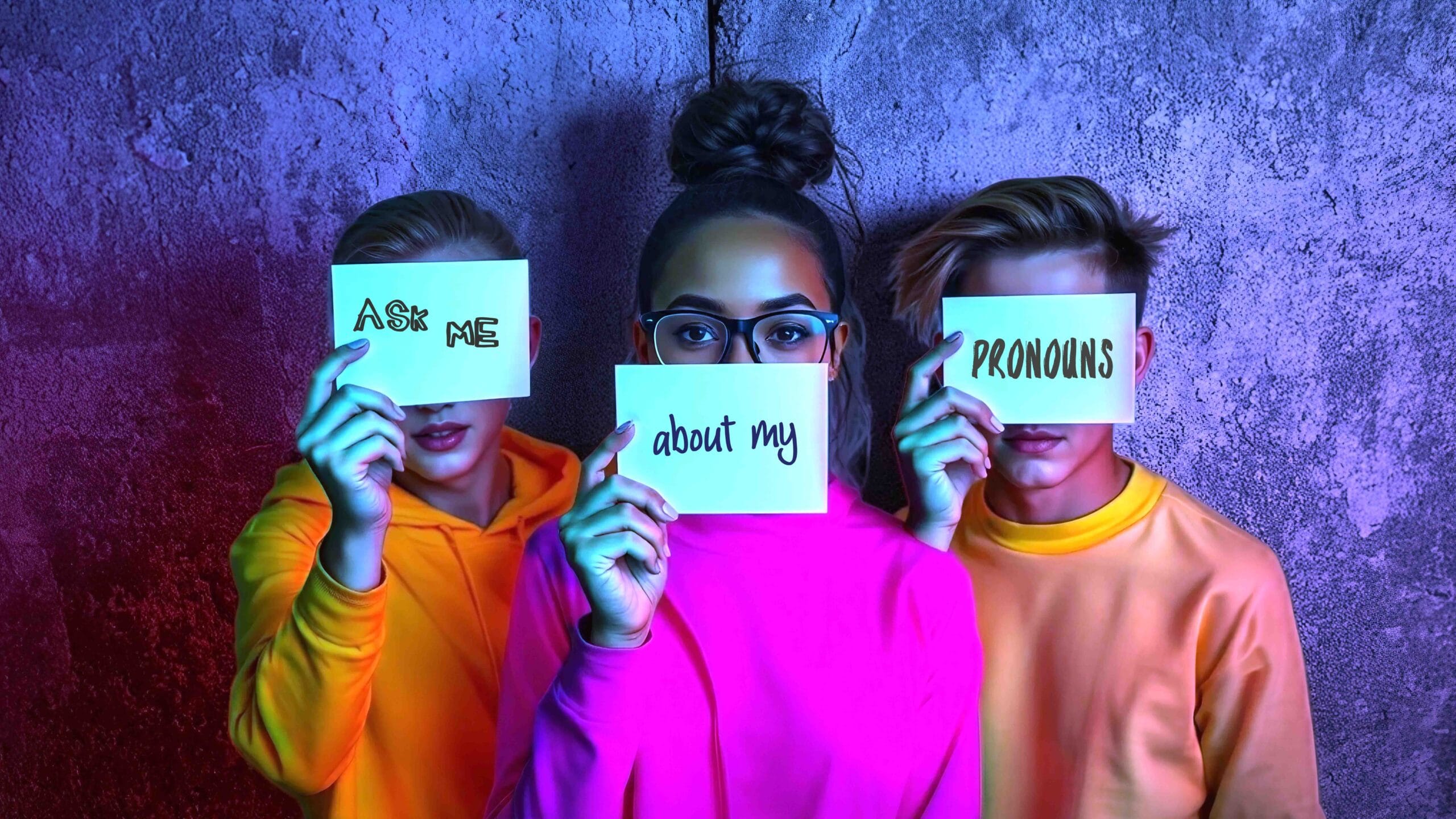
But for Christian students, that handshake comes with sweaty palms. Should they play along to be kind? Should they stand their ground and risk sounding like the group text Pharisee? And the million-dollar youth group question: how do you stand for truth without losing every last one of your friends?
Working with young people, especially in the church, places you in a privileged position of influence where you can provide a safe place for students to ask their questions and wrestle with the challenge of living for Christ in a culture that has had two extra scoops of crazy. To help you do just that, let’s break down the topic of gender and pronouns to a manageable level so that you can help students navigate this cultural craze with clarity, courage, and compassion.
Sex and Gender: Clearing the Fog
The first step to clearing the cultural fog is by getting some definitions right. Make sure students understand the difference between sex and gender.
- Sex is biological. It’s stamped into our DNA as male or female (Gen. 1:27). Chromosomes, reproductive systems, and hormones testify to this reality.
- Gender, in today’s culture, is treated as psychological and social. It’s seen as something we can construct, express, and reinvent at will.
This distinction is new, as in 1950’s new. However, for most of history, “sex” and “gender” were interchangeable terms and your options were binary: you were either female or male, there is no third or thirtieth category.
Confusing intersex with gender identity issues is a category mistake. Those born with intersex traits deserve dignity and pastoral sensitivity, but they are not evidence of multiple genders.
The Reality of Intersex and the Fall
Some will quickly object: “But what about people born intersex?” That’s a fair question. Intersex refers to a small percentage of people born with ambiguous or atypical sex characteristics. This is real and deserves compassion.
But here’s the key: intersex is a medical condition, not a third gender. It reflects the brokenness of creation after the fall (Rom. 8:20–22), not a new category for humanity. Just as blindness does not create a third category of vision, intersex does not create a third gender.
Confusing intersex with gender identity issues is a category mistake. Students need to understand that God created humanity male and female, but the fall introduced disorder. Those born with intersex traits deserve dignity and pastoral sensitivity, but they are not evidence of multiple genders.
Gender Dysphoria vs. Intersex
Which leads us to our next point: intersex and gender dysphoria are not the same thing.
- Intersex is biological—it shows up in the body. Think of it as a rare medical condition, like being born with an extra tooth in a place it doesn’t belong. It happens, but it’s not common. In fact, true intersex cases under a narrow definition occur in only about 0.018% of births—that’s rarer than finding a Chick-fil-A open on Sunday. Broader definitions that include everyone from your aunt wrestling with a collection of chin hairs that just won’t quit, to that kid down the street who looks and acts like a little boy but happens to have an extra Y chromosome, bump this statistic up to around 1–2%, but still, it’s uncommon.¹
- Gender dysphoria is psychological—it’s the distress someone feels when their internal sense of gender identity doesn’t line up with their biological sex. That’s not a body issue, it’s a perception issue.
Why is this distinction so important? Because culture often blurs the two together to prop up transgender ideology. But while both are the result of the fall, scientifically, they’re apples and oranges.
And here’s the kicker: while intersex is rare, gender identity issues are skyrocketing. Roughly 0.6% of Americans identify as transgender overall,² but among teens (ages 13–17), that number jumps to 3.3%—and young adults 18–24 aren’t far behind.³ Even more eye-popping, the number of young adults identifying as transgender has reportedly grown ten- to twelve-fold in less than a decade.⁴ That’s not biology at work—that’s a cultural contagion on steroids.
The Problem with Pronouns
So what about pronouns? Once upon a time, they were simple little words tied to biology—he, she, him, her. Now, they’ve been hijacked to describe how a person feels on the inside. The problem? Just because a small slice of the population rewrote the dictionary in their group chat doesn’t mean the rest of the English speaking world signed off on it.
Sure, some insist pronouns are a matter of personal choice. But for most people, they’re still basic grammar tools pointing to a biological reality. Hanging on to that definition isn’t hate speech, it’s common sense. A biological male may “identify” as they/them and claim to be non-binary, but that doesn’t mean the rest of the world is required to pretend pronouns magically jumped from the category of biology to identity. One could completely embrace gender theory and still recognize that pronouns have a double duty, and biology is one job they’re not quitting anytime soon.
Next comes the sticky question: should Christians use someone’s “preferred pronouns” as a gesture of kindness?
Answer: The Bible doesn’t actually give us a verse that says, “Thou shalt not use preferred pronouns.” But, it does give us some guiding principles that apply no matter where or when we live:
- Truth matters. God spoke the world—and reality itself—into being. Our words don’t carry that kind of power, but they do carry weight. When we use language that affirms something untrue about a person, we’re not being kind; we’re affirming a distortion, a rejection of reality. In the end, it’s a lie, and God forbids lying, no matter how well-meaning it is (Ex. 20:16).
- Words matter. Using pronouns that deny biological reality is basically endorsing a theory younger than your grandma’s toaster—one with zero scientific backbone and a lot of broken lives in its wake. No matter how someone feels on the inside, language that props up an identity at odds with biology keeps them stuck in a kind of limbo—chasing an identity their body can never deliver, while being pulled further from the kind of healing only truth can bring.
- Love matters. Anyone who feels so uncomfortable in their own skin (whether because of mental health struggles, past trauma, or abuse) that they long to be identified as something other than what they are doesn’t need our condemnation; they need our compassion. Yes, we’re called to speak the truth in love (Eph. 4:15), but love never makes room for cruelty, mockery, or dismissiveness.
Pronouns have become a cultural game that you don’t have to play. Most of the time, we use pronouns when the person isn’t even in the room. So unless there’s a “pronoun police” ready to file a report, they’re probably not going to notice. And here’s an easy workaround: just use their name. It’s respectful, it avoids unnecessary offense, and most importantly, it keeps you from speaking something untrue. Plus, people usually like hearing their own name anyway.
The Bible doesn’t actually give us a verse that says, “Thou shalt not use preferred pronouns.” But, it does give us some guiding principles that apply no matter where or when we live.
Guiding Students in Grace and Truth
Youth leaders are in a unique position to equip students with both conviction and compassion. Here are a few practical talking points:
Respect without compromise. Kindness doesn’t require bending reality. Coach your students with simple, gracious lines like: “I care about you, but I believe God made us male or female, so I can’t use pronouns that deny that.” It’s clear, it’s calm, and it’s not a sermon crammed into a cafeteria conversation.
Names vs. pronouns. Don’t die on the “name” hill. If Lucy wants to go by Jack, fine—nicknames and name-swaps have been happening since the book of Genesis. But pronouns are a whole different ballgame. Names are preference; pronouns make a claim about reality. Help your students understand why one is courtesy and the other is compromise.
Wise as serpents, gentle as doves. (Matt. 10:16). Translation? Teach students how to be clear without being cruel. They don’t have to endorse falsehood, but they also don’t need to stomp on people’s feelings for sport. You can refuse to endorse something that is false without going the extra mile to offend someone.
Pastoral Encouragement for Leaders
This conversation is not just cultural—it’s deeply personal. Many students are confused, pressured, or genuinely hurting. Some may even be wrestling with their own gender identity, while others are terrified of losing friends if they don’t “get with the program.”
As leaders, remind them:
- A person’s value and identity is rooted in God, not labels.
- Love and truth are friends, not enemies. It’s when you get one without the other that problems start.
- They don’t have to fear rejection, Jesus Himself was rejected (John 15:18).
- Their calling is faithfulness, not popularity (Gal. 1:10).
Encourage them to lean into the church community for strength and wisdom and model what it looks like to love people without lying to them.
A person’s value and identity is rooted in God, not labels.
Final Word for Leaders
The pronoun craze is not just about words—it’s about reality. Students today are being asked to choose between affirming cultural lies and standing with biblical truth. That’s a heavy burden for teenagers, but with your guidance, they can navigate it well.
Equip them to see the difference between sex and gender, to understand the reality of intersex conditions without distortion, to separate intersex from gender dysphoria, and to engage the pronoun debate with grace and truth.
The world tells them: “Change your words, change reality.” Scripture tells them: “Speak the truth in love.” When our students live that way, they’ll not only stand firm in a confusing culture, they’ll shine as lights for Christ.
Footnotes
1. Leonard Sax, “How Common Is Intersex? A Response to Anne Fausto-Sterling,” The Journal of Sex Research 39, no. 3 (2002): 174–78, https://pubmed.ncbi.nlm.nih.gov/12476264/.
2. Jody L. Herman, Andrew R. Flores, and Kathryn K. O’Neill, How Many Adults and Youth Identify as Transgender in the United States? (Los Angeles: Williams Institute, UCLA School of Law, 2022), 3–4,https://williamsinstitute.law.ucla.edu/wp-content/uploads/Trans-Pop-Update-Jun-2022.pdf.
3. Johns, Michelle M., et al. “Transgender Identity and Experiences of Violence Victimization, Substance Use, Suicide Risk, and Sexual Risk Behaviors Among High School Students—19 States and Large Urban School Districts, 2017.” Morbidity and Mortality Weekly Report 68, no. 3 (2019): 67–71. Updated with 2023 CDC data: “Youth Risk Behavior Surveillance—United States, 2023.” MMWR Supplements 73, no. 4 (2024): 1–48, https://www.cdc.gov/mmwr/volumes/73/su/su7304a6.htm.
4. Gallup, “LGBT Identification in U.S. Ticks Up to 7.6%,”Gallup News, February 28, 2024, https://news.gallup.com/poll/512045/lgbt-identification-ticks.aspx; see also Williams Institute, Transgender Population Update (2025), which shows disproportionately higher identification rates among younger cohorts.